

This information was compiled by GWSC Communications Intern Emily Wright, based on a GWSC product completed by Human-Environmental Analyst Penny Beames, Data Scientist Erin Menzies Pluer , and Cartographer Emma Dyson.
Water security across Central Asia is inextricably tied to both energy systems and agricultural stability.
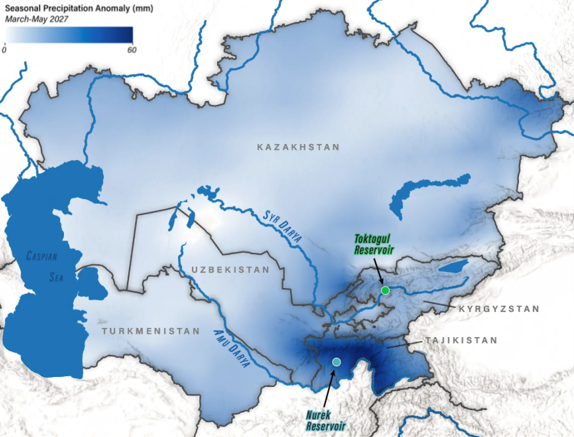
Low levels in major hydroelectric reservoirs, war-related fuel shortages, and summer heatwaves have created vulnerabilities throughout the region. The Global Water Security Center’s analysis teams found that forecasts for winter and spring 2026–27 predict that higher-than-normal snow and rainfall could refill depleted reservoirs, support crops, and ease economic strains.
Kyrgyzstan and Tajikistan
Hydropower accounts for 90-98% of electricity generation in Kyrgyzstan and Tajikistan. With water levels in the Nurek and Toktogul Reservoirs critically low, both domestic energy and irrigation supplies for several downstream nations are limited. Depleted surface area at Kyrgyzstan’s Toktogul Reservoir has constrained energy production.
These shortages carry severe risks, as hydropower deficits contributed directly to the country’s 2010 revolution. And in July 2026, severely low levels at the Nurek Reservoir prompted Tajikistan to announce winter power rationing measures. These cutbacks expose households to extreme winter conditions that have historically sparked public protests.
Kazakhstan
Agricultural regions downstream from Kyrgyzstan and Tajikistan depend heavily on water from upstream reservoirs for crop irrigation. During the spring 2026 planting season, farmers in Kazakhstan cultivated a record sowing area. But in May and June, heatwaves, low rainfall, and irrigation shortages damaged crops and reduced harvest projections.
The Global Water Security Center’s research found that rainfall expectations for spring 2027 demonstrate a vital opportunity for agricultural recovery and improved food security in Kazakhstan.
Uzbekistan and Turkmenistan
Severe drought conditions and irrigation shortfalls have drastically lowered crop yields in Uzbekistan and Turkmenistan. Wheat production dropped by 9% in Uzbekistan and 33% in Turkmenistan during the 2025-26 harvest season, creating intense strain for domestic food supplies and rural livelihoods.
The Global Water Security Center found that rainfall increases offer hope for recovery efforts in 2026-27, including restoration of agricultural yields and reductions in reliance on wheat imports.
Looking Forward
According to Global Water Security Center analyses, anticipated spring 2027 rains promise much-needed relief for Central Asia. However, long-term stability requires careful stewardship of resources.
Kyrgyzstan, Tajikistan, Kazakhstan, Uzbekistan, and Turkmenistan must cooperate to balance winter energy needs upstream with summer irrigation demands downstream. Coordinated water management methods will be essential in preventing power blackouts, protecting agricultural livelihoods, and maintaining regional stability.