
This information was compiled by GWSC Communications Intern Emily Wright, based on a GWSC product completed by Human-Environmental Analyst Penelope Mitchell, Data Scientist Lynn Metz, and Cartographer Emma Dyson.
Northern Mexico faces chronic water scarcity, multi-year droughts, expanding agricultural demands, and a surge in high water usage manufacturing driven by nearshoring. These overlapping pressures threaten local livelihoods, strain international treaties, and create fertile ground for organized crime and civil unrest.
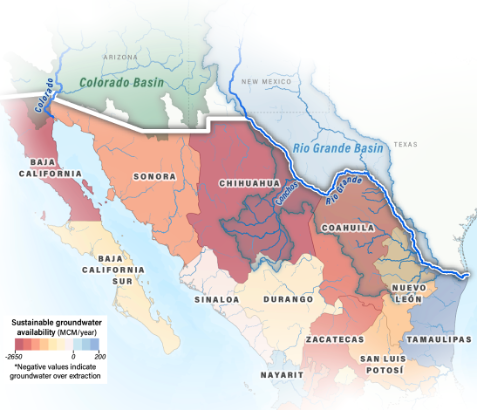
In regions like Sonora, Sinaloa, the Baja Peninsula, and the Rio Grande basin, both surface water and underground aquifers are rapidly being depleted. Because almost all northern aquifers are in deficit due to extraction far exceeding natural recharge, the region faces an unsustainable ecological imbalance. Water is no longer just an environmental or agricultural issue, but has become a central driver of social, economic, and geopolitical tension.
Rising Tensions
Longstanding international agreements govern water distribution across the U.S.-Mexico border. Under the 1944 treaty framework, Mexico should receive 1.5 million acre-feet of water annually from the Colorado River and, in return, should deliver 350,000 acre-feet per year to Texas from six Rio Grande tributaries.
However, multi-year droughts have strained this balance. Drought-driven reductions in U.S. allocations from the Colorado River have severely impacted municipal water supplies and farming in Baja, California. Additionally, Mexico has consistently fallen behind on its required Rio Grande deliveries. The Rio Conchos, which serves as Mexico’s primary tributary for fulfilling treaty obligations and is historically responsible for 70% of the Rio Grande’s flow, has suffered severe declines in water levels.
When the Mexican government attempts to divert water to satisfy cross-border obligations, local communities and farmers resist fiercely. Protests, blockades, and dam seizures like the takeover of La Boquilla Dam in Chihuahua highlight how treaty obligations can ignite civil unrest within Mexico. To meet debts, the nation has even had to tap non-treaty tributaries like the San Juan River, drawing further public discontent.
Agricultural Limitations
Though agriculture represents roughly 4% of Mexico’s GDP and serves as the economic backbone for many northern states, it is both a primary driver and a major victim of water scarcity. Peak drought conditions reduced irrigated farmland in northern states by nearly 20%. In Sinaloa, a primary agricultural hub, maize production dropped by over half in 2024, driving up tortilla prices and threatening a foundational Mexican dietary staple.
Cotton production in Chihuahua was similarly halved after extreme heat-dehydrated cotton bolls. Scarce water, prolonged heat, and lack of forage led to the death of over 500,000 cattle, forcing ranchers into herd liquidations and relocations herd liquidations and relocations.
Consecutive dry days have more than doubled in arid zones, while days exceeding 35°C or 95°F increased by 35% to 50% over historical averages. High temperatures force irrigation systems to compete directly with urban air conditioning for electricity. Peak demand triggers power outages that shut down irrigation pumps, further damaging crops. When waterlaw reforms [MM1] were proposed in late 2025 that farmers perceived as weakening their water rights, agricultural groups responded with widespread blockades to defend their livelihoods.
Nearshoring Complications
Northern Mexico’s proximity to the United States makes it an ideal location for “nearshoring,” or attracting advanced tech supply chains and manufacturing. However, expanding these industries without a comprehensive water strategy creates severe resource conflicts.
Developing Mexico’s estimated 1.7 million metric tons of lithium reserves, which are primarily in located in Sonora, using direct lithium extraction methods could require up to 18 million cubic meters of potable water annually. Modern chip manufacturing requires steady power and roughly 16 million cubic meters of water per facility each year.
With 73 new data centers planned by 2029, most of which are concentrated in states like Nuevo León and Durango, cooling needs will add massive stress to local water networks. Major open-pit mines in Sonora rely on heavy water concessions, drawing direct protests from nearby residents suffering shortages.
Water theft, illegal pipeline connections, and illicit control account for a staggering 15% loss of Mexico’s national water supply. Cartels and specialized “hydromafia” networks increasingly extort irrigation allocations, control water tanker deliveries, and manipulate concessions. As water becomes scarcer and more valuable to high-tech operations, organized crime gains stronger financial incentives to seize control of local water distribution.
Looking Ahead
Water scarcity in Northern Mexico is no longer a seasonal environmental hurdle. It is an overarching crisis affecting economic stability, national food security, and governance.
Without strategic, long-term water management that balances agricultural needs, industrial growth, and civic access, Northern Mexico risks intensifying social unrest, deepening disputes with the U.S., and leaving critical resource networks vulnerable to exploitation by organized crime.