
This post was compiled by GWSC Chief of Staff Misty Mathews, based on a GWSC product completed by Human-Environmental Scientist Penny Beames, Data Scientist Erin Menzies-Pluer, and Cartographer Emma Dyson.
On June 2, the World Meteorological Organization estimated an 80% likelihood of an El Niño event from June to August 2026, with a 90% chance that it will continue through November. El Niño events typically persist into the following year.
News media have latched onto the term “Super El Niño” to describe the coming event. The term conjures disastrous images. But it’s important to keep in mind that forecasts can change this far out, and focusing on the strength of the weather phenomenon may distract from impacts that can occur regardless of whether it’s moderate or Godzilla.
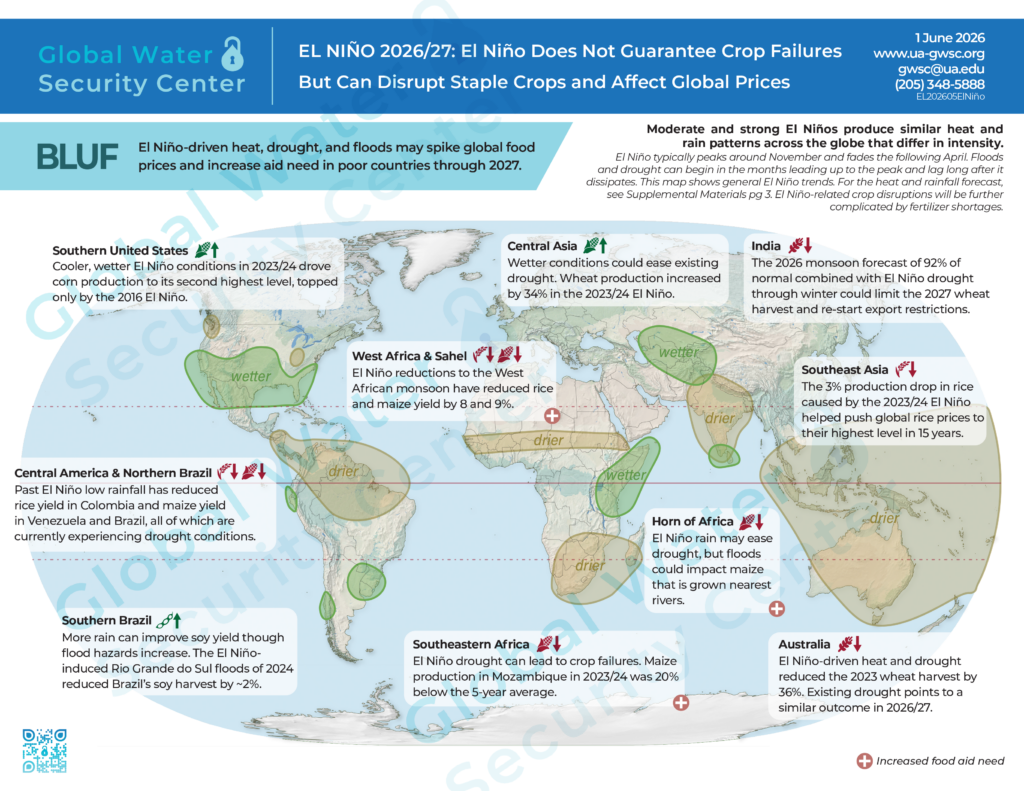
The Global Water Security Center’s analysis team recently completed an overview of anticipated 2026 El Niño impacts. Click the image to view the full product or to download a screen reader friendly version.
The Global Water Security Center (GWSC) analysis team recently looked at historical El Niño patterns and global forecast models to examine the potential impacts to global crop production. The team found that heat, drought, and floods may reduce staple crop yields in certain parts of the world which could have far-reaching consequences for global prices.
And the effects will be felt well beyond the end of the weather phenomenon. El Niño-driven heat, drought, and floods may spike global food prices and increase aid need in poor countries through 2027.
El Niño Projected to Drive Higher Temperatures and Weather Extremes
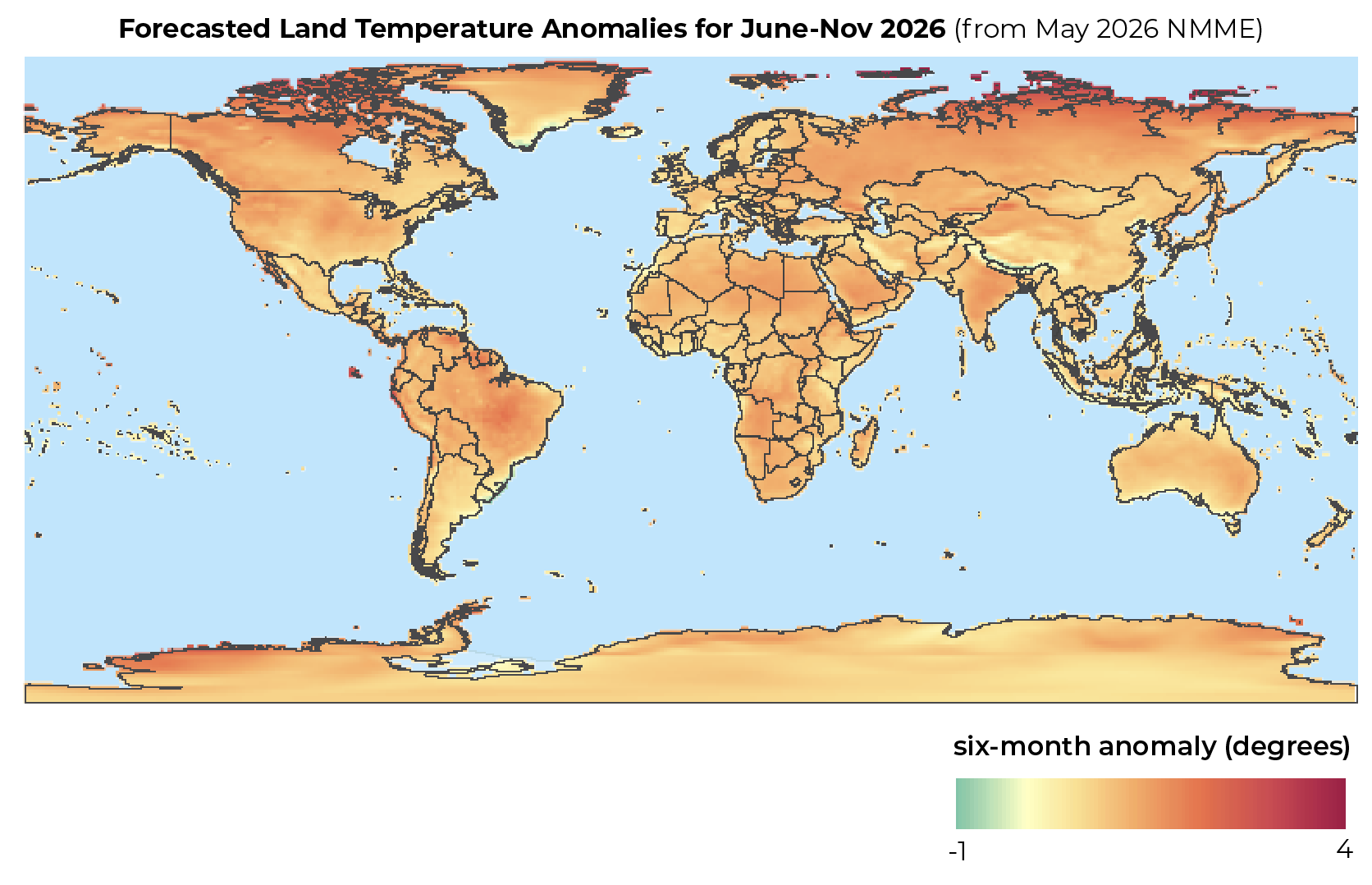
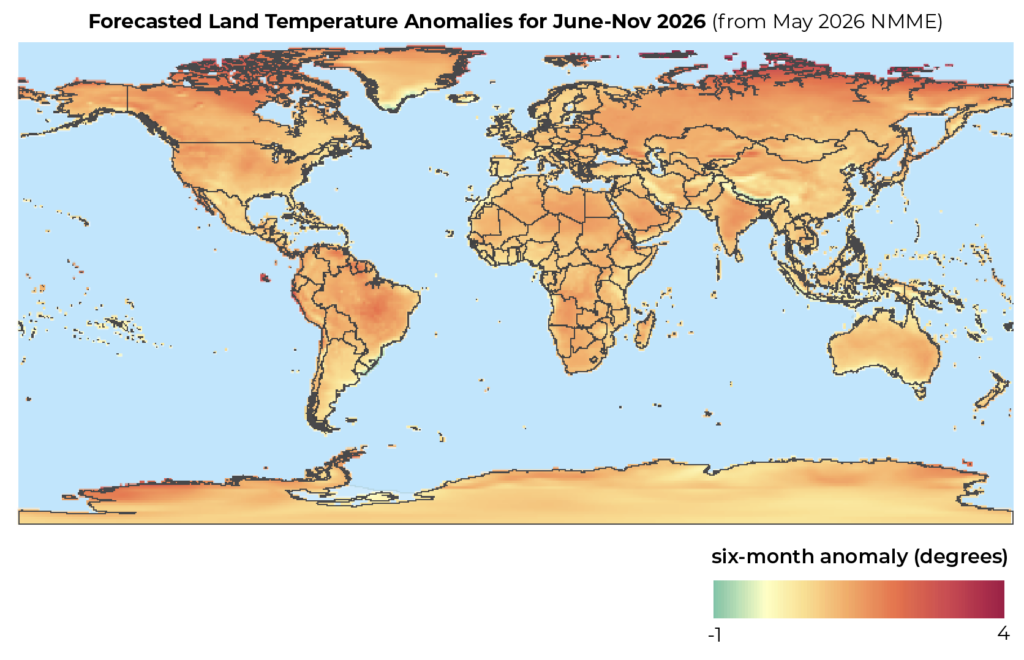
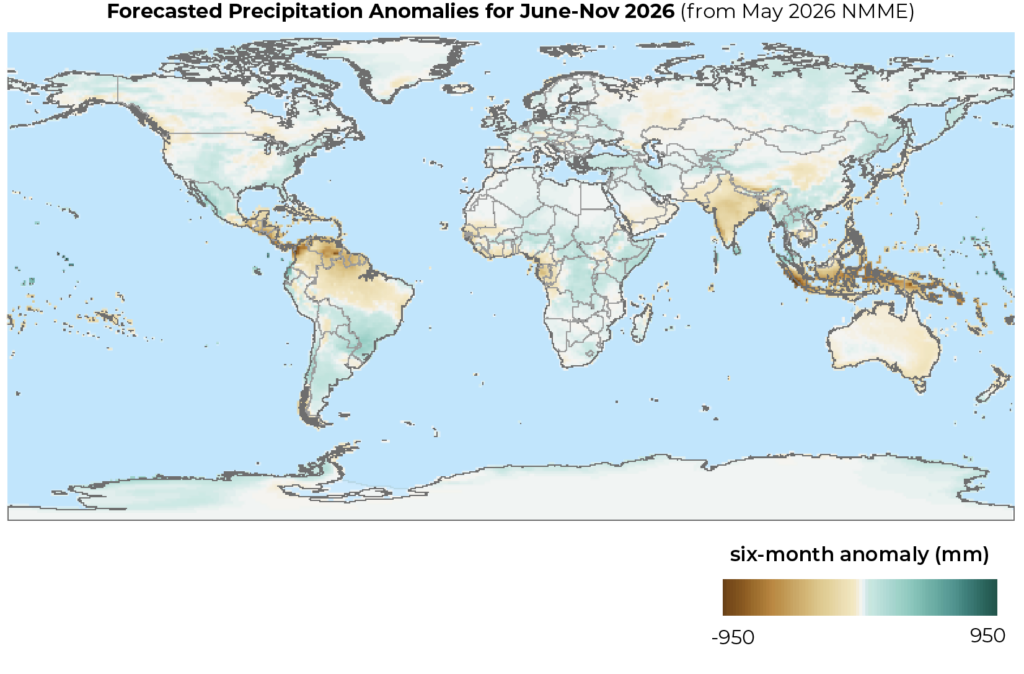
GWSC turned to the North American Multi-Model Ensemble (NMME) to assess global temperature and precipitation forecasts for the coming months.
Based on NMME outputs, roughly 96% of the planet’s land surface is forecast to experience above-normal temperatures leading up to the El Niño peak in November. Arctic anomalies are projected to be the most extreme at 3-4ºC above normal.
The six-month cumulative rainfall anomaly forecast shows El Niño patterns taking shape in the form of severe drought across Central America and Oceania.
El Niño Does Not Guarantee Crop Failures But Can Disrupt Staple Crops and Affect Global Prices
El Niño weather patterns have mixed impacts across the world. The United States and Central Asia may benefit from wetter conditions. Hotter temperatures and drought and floods in other parts of the world may still produce strong impacts in global crop production. A breakdown of GWSC’s assessments by region are found below.
Southern United States: Cooler, wetter El Niño conditions in 2023/24 drove corn production to its second highest level, topped only by the 2016 El Niño.
Central America & Northern Brazil: Past El Niño low rainfall has reduced rice yield in Colombia and maize yield in Venezuela and Brazil, all of which are currently experiencing drought conditions.
Southern Brazil: More rain can improve soy yield though flood hazards increase. The El Niño-induced Rio Grande do Sul floods of 2024 reduced Brazil’s soy harvest by ~2%.
West Africa & Sahel: El Niño reductions to the West African monsoon have reduced rice and maize yield by 8 and 9%.
Horn of Africa: El Niño rain may ease drought, but floods could impact maize that is grown nearest rivers.
Southeastern Africa: El Niño drought can lead to crop failures. Maize production in Mozambique in 2023/24 was 20% below the 5-year average.
Central Asia: Wetter conditions could ease existing drought. Wheat production increased by 34% in the 2023/24 El Niño.
India: The 2026 monsoon forecast of 92% of normal combined with El Niño drought through winter could limit the 2027 wheat harvest and re-start export restrictions.
Southeast Asia: The 3% production drop in rice caused by the 2023/24 El Niño helped push global rice prices to their highest level in 15 years.
Australia: El Niño-driven heat and drought reduced the 2023 wheat harvest by 36%. Existing drought points to a similar outcome in 2026/27.